How to understand TV series by ear: next steps after theory
If you already know the basics of a language but still can't follow a series in it by ear, you're missing a step in between. You need real speech, but speech you can stop, replay and translate without opening a dictionary in another tab. Below: why this happens, how many words a series takes, when subtitles help, and what to do while series are still too hard.
Why you can't follow a series even though you know the words
You already read freely: articles, posts, subtitles. But in a series, familiar words fly past. Actors speak fast, words run together, endings get swallowed. You recognise a word a second after it was said, and in that second two more sentences have gone by.
Recognising words by ear is a separate skill. It grows when you listen to a lot of speech you almost understand. If you miss half of it, listening is just exhausting, and you quickly give up on the series.
How many words you need for a series
According to linguists' counts (Webb and Rodgers, 2009), about 3,000 of the most frequent words with their forms, plus names, cover roughly 95% of all words in an ordinary TV programme. At that point you can follow the plot from the picture, but every twentieth word is unfamiliar, which is about one word in every second or third line. To watch comfortably you need closer to 98%, and that means several thousand more words.
And that's assuming you recognise the words you know when you hear them. That's why, at the intermediate level, you need to train vocabulary and listening together.
Subtitles help, but only so far
Subtitles in the language you're learning are useful: you hear a word and immediately see how it's spelled. Familiar words stick better that way. But in the end you read the meaning rather than hear it, and without subtitles the same scene becomes hard to follow again.
Subtitles in your native language are worth turning on in two cases. First: you know the words one by one, but the meaning of the sentence doesn't come together. Second: an easy series has a hard scene, like a business conversation in a romantic comedy. If you understand nothing without native subtitles, it's too early for that series.
A step in between: series made for language learners
Between learning materials and ordinary TV there are series made specifically for people learning a language. The plot is simple, people speak slower and more clearly, and the vocabulary is chosen for learners. For example:
- Extr@ — a sitcom about a foreigner who moves in with his new neighbours and learns their language. There are English, Spanish, French and German versions.
- Nicos Weg by Deutsche Welle — a free series for learners of German, with exercises for every episode.
- Mi Vida Loca by the BBC — a short interactive series for Spanish.
- Destinos (Spanish) and French in Action (French) — old but thorough learning series.
If a series like this matches your level, start with it: it's the gentlest way from learning materials to real speech.
If that doesn't work either, try an interactive novel with voice acting
Sometimes you've already watched the learner series, they feel boring, or they're still hard. For the language you're learning there may simply be none. Then it's worth trying another format: a game made specifically for language learners. Like a series, it has a story and voices, but you can take every sentence on its own, at your own pace. And it has tools to translate and reinforce new words and phrases.
That's the game I made: Interview with Emma. It's a visual novel, a story told in pictures, where the characters talk and you read and listen. You play as Emma, a first-year journalism student. She says goodbye to her mom at the campus and meets her roommates and new people. The conversations are about moving, studying and first crushes, without technical terms in every line.
Why it's closer to studying than an ordinary series:
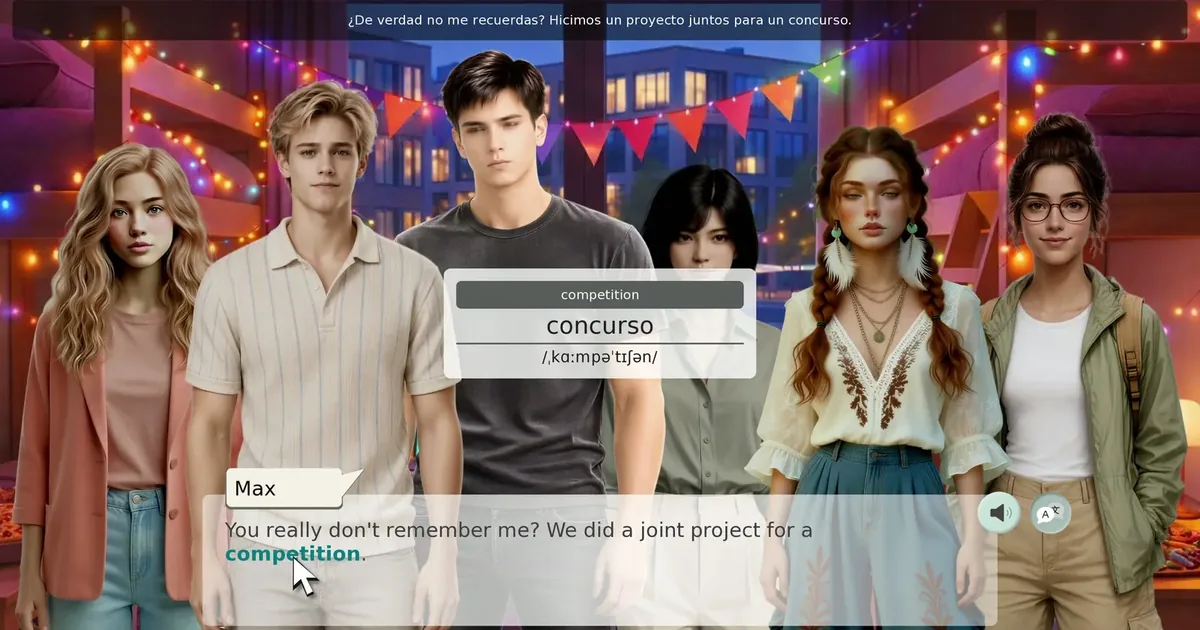
- The story waits for you. The next line starts only when you tap. You can reread and replay as much as you need.
- Every line is voiced, and each character has their own voice. You can replay any line and repeat it after the character at your own pace.
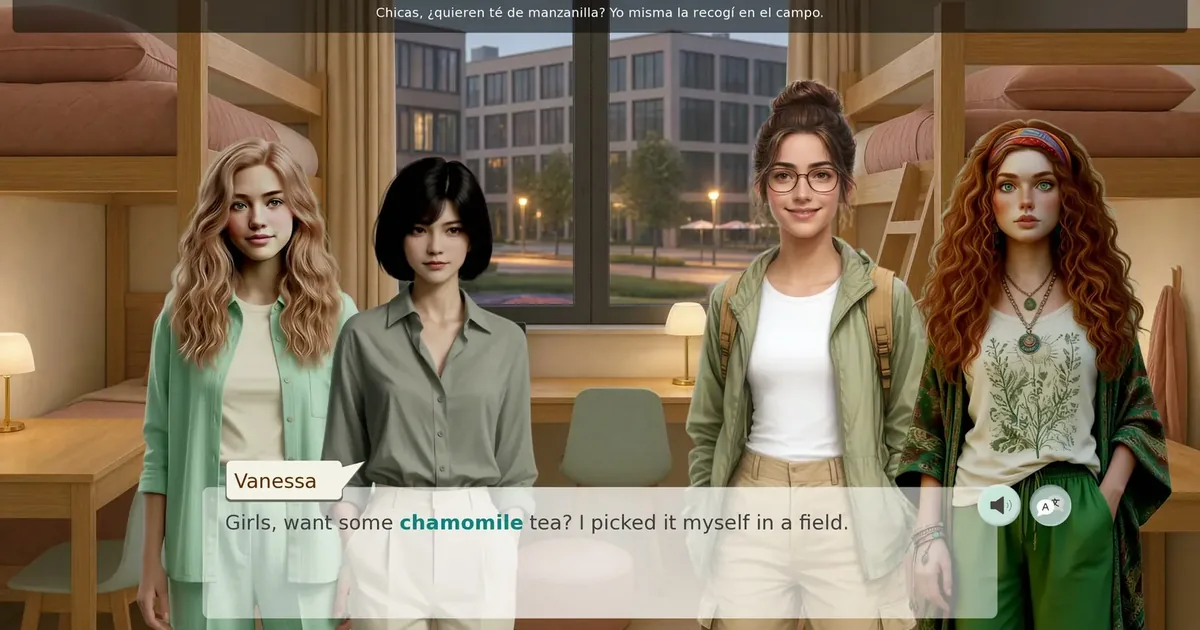
- You can translate any word: tap it and you see the translation. The words the scene teaches are highlighted: they also have a transcription and audio, so you can hear how the word sounds on its own.
- If a whole line is unclear, you can translate the entire sentence.
- Karaoke: subtitles in two languages follow the voice.
- Before the scene there's a list of its words, after it a short quiz, including listening questions.
How to study, using one scene as an example
This is how I'd go through one scene, it takes 10–15 minutes:
- Look through the word list before the scene and listen to the words.
- Play the scene in the language you're learning. Translate a whole line only if the meaning escapes you completely.
- Replay the hard lines and repeat them out loud after the character.
- Take the quiz.
Example lesson for learners of Spanish — the first scene of the game:
You can play the beginning of the story for free. In the game you can learn English, Spanish, French, Italian, German, Portuguese and Turkish, with translations in your native language.
More about the word lists, quizzes, karaoke and the scene map on the game page. Why a story sticks better than a word list: Interview with Emma: a game for learning a language through a story.
Questions and answers
Can you learn a language from TV series?
Yes, but a series teaches well when you understand most of what is said. If the meaning slips away in almost every line, the series is too hard for now: you need easier material or a step in between.
How many words do you need to watch a series without subtitles?
According to linguists' counts, about 3,000 of the most frequent words (with their forms) plus names cover roughly 95% of the words in an ordinary TV programme. To watch comfortably you need more, closer to 98%.
When should you turn on subtitles in your native language?
When you know the words one by one but the meaning of the sentence doesn't come together, or when an easy series has a hard scene. The rest of the time, subtitles in the language you're learning work better.
What level is Interview with Emma for?
Intermediate (A2–B2): you know the basics of the language, but real speech is still hard to follow. The dialogue is everyday speech, and any word or a whole line can be translated with one tap.